Triple Ball Screen Action: A Ball-Screen Play That Breaks Down Any Defense
 Most teams can guard one ball screen. A lot of teams can survive two. Very few can string together three clean coverages in a row without somebody making a mistake — and that’s the entire idea behind Triple Ball Screen Action.
This is a man-to-man play built on one simple, ruthless principle: keep putting the ball handler downhill off a fresh screen before the defense can reset. By the third screen, somebody is late, somebody is confused about who’s switching, and a high-percentage shot opens up. As a coach, I love this set because it doesn’t depend on a perfectly drawn-up read — it manufactures advantages through sheer repetition and pressure on the defense’s communication.
Here’s the full breakdown of how it works, the reads off each screen, the coaching points that make it dangerous, and how to drill it.
The Concept: Why Three Screens in a Row Works
A single ball screen forces a defense to make one decision: switch, hedge, drop, or go over the top. Each of those decisions has a counter, but a good defense only has to win one read to stop the play.
Continuous ball screens flip that math. Every screen forces a new decision, and every decision is another chance for a breakdown:
- The on-ball defender has to fight over screen after screen, and fatigue and trail position compound with each one.
- The screeners’ defenders have to keep choosing between helping, hedging, and recovering — and they have to communicate it cleanly every single time.
- A switch that looks fine on the first screen creates a mismatch that the next screen can attack immediately.
You’re not trying to beat the defense once. You’re asking them to be perfect three times in a row, under speed, against movement. They rarely are.
The Starting Alignment
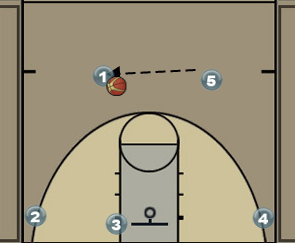
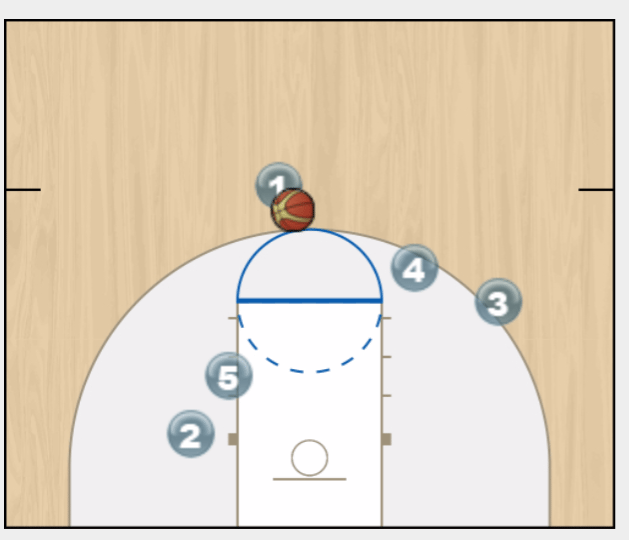
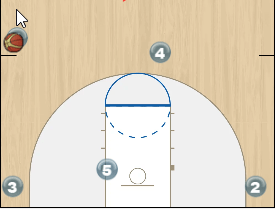
The play sets up in a box / 1-4 style alignment:
- 1 (point guard) has the ball up top.
- 4 and 5 start high, near the elbows.
- 2 and 3 start lower, toward the blocks/short corners.
This alignment matters. Starting the screeners high and the shooters low gives you a clean lane to run the ball-screen train through the middle of the floor, and it keeps the corners and wings available as spacing once the action gets going.
The Action: Three Screens, One Continuous Attack
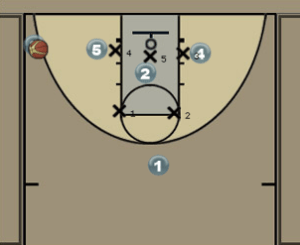
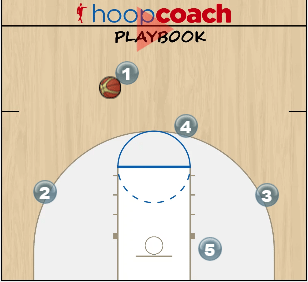
The heart of the play is the ball handler attacking off three consecutive on-ball screens, working across the floor rather than in one spot.
Screen 1 — get downhill. The first screener climbs into an on-ball screen and the point guard attacks off it hard, turning the corner toward the middle. The goal here isn’t necessarily a shot — it’s to commit the defense and get the on-ball defender on his heels.
Screen 2 — re-screen before they recover. As the handler comes off the first screen, the second screener is already stepping up to meet him. There’s no pause. This is what stresses the defense: the on-ball defender is still recovering from the first screen when he runs straight into the second. Any hedge-and-recover scheme starts to crack here.
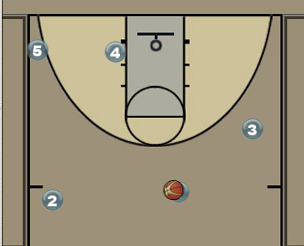
Screen 3 — punish the breakdown. By the third screen, the defense is almost always a step behind. The handler attacks the last screen with a live read: turn the corner for a layup, snake the dribble back if they go under, or pull up if they trail. Meanwhile the screeners and shooters have spaced out, so help defenders are stretched thin.
Throughout, the screeners who aren’t currently screening relocate to keep the floor balanced, and the off-ball shooters lift or fill to wing and corner spots so there’s no easy help.
The Reads off Each Screen
Teach your ball handler to read the on-ball defender and the screener’s defender on every screen — same menu each time:
- Defender goes under → pull up or attack the gap before he recovers.
- Defender goes over / trails → turn the corner and get to the rim.
- Defense hedges or shows → split it or snake the dribble back to create the re-screen angle.
- Defense switches → attack the mismatch immediately, or use the next screen to hunt an even better one.
- Help comes off a shooter → kick to the open man. The spacing is the safety valve on every rep.
The point guard should never feel locked into “get to screen three.” If screen one gives him a layup, he takes it. The triple action is insurance, not an obligation.
What the Screeners Must Do
The screeners are what make or break this set:
- Sprint into screens and hold them. A drifting, soft screen lets the defender slide through and the whole sequence dies.
- Screen the man, not the spot. Find the defender’s body and make legal, physical contact.
- Read your own defender after the screen. If your man helps on the ball, roll to the rim. If he sags off, pop for the shot. Each screener becomes a live pick-and-roll threat the instant the handler clears.
- Time the next screen. The second and third screeners can’t be early (the handler isn’t there yet) or late (the defense recovers). Rep the timing until it’s automatic.
Coaching Points
- Pace is the weapon. The screens have to come in quick succession. If there’s a beat of standing around between them, you’ve given the defense the reset it needs.
- Keep two passing outlets live at all times. As the ball moves through the screens, your shooters must relocate so the handler always has a kick-out if help shows.
- Don’t over-dribble. The handler should attack with purpose off each screen, not pound the air out of the ball waiting for the next one.
- Build in a counter. If the defense survives all three, flow straight into your motion or a flare/stagger for a shooter so it never becomes a dead possession.
- Screeners are scorers, not statues. Every roll and pop is a real scoring threat — treat them that way and the defense can’t fully commit to the ball.
How to Drill It
You don’t need the full five to teach the concept:
- 2-on-2 continuous ball screen. One screener, one handler, live defense — the handler attacks, the screener re-screens, repeat for three reps. Builds the over/under reads and the roll/pop habit.
- 3-on-3 “screen the screener” flow. Add the third player to work on timing the consecutive screens and relocating.
- 5-on-0 walk-through, then 5-on-5 live. Lock in the spacing and the order of screeners before you let the defense scramble it.
When to Use Triple Ball Screen Action
This set is excellent against switch-heavy or drop-coverage man defenses, and it’s a strong call when you have a downhill guard who can make decisions at speed plus a couple of bigs who can both screen and finish or pop. It works as a primary half-court action, a late-clock generator, or an out-of-timeout look when you want to force the defense to communicate under pressure. Against zones it’s less effective — save it for man-to-man.
Get the Play
Watch the animation and grab the diagrams in our play designer to see the spacing and screen timing in motion, then walk your team through it before running it live.
Download a PDF for Triple-ball-screen or check out the animation
Looking for more ball-screen and man-to-man sets? Browse the full Basketball Plays library on Hoop Coach.