Play Breakdown: Box Double High Screen Set
When facing a stagnant defense or a team that excels at loading the help side, introducing multiple actions to force defensive shifts is essential. This breakdown details a Box Double High Screen set. The primary objective of this action is to use early misdirection to scramble the defense, forcing multiple closeouts and help-side rotations, before entering a spread double ball screen at the top of the key.
Here is a breakdown of the timing, spacing, and personnel responsibilities required to execute this set effectively.
Execution and Film Breakdown
Phase 1: Box Entry and Initial Decoy
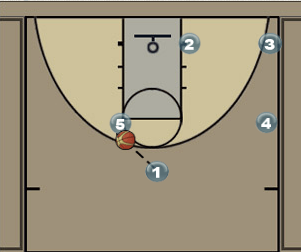
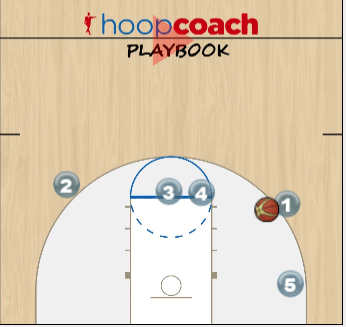
The set initiates from a standard Box alignment. Players 4 and 5 are positioned at the elbows; Players 2 and 3 are on the low blocks.
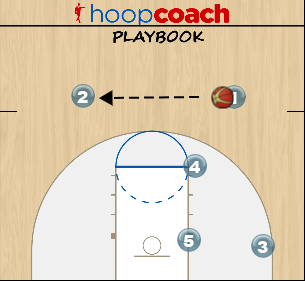
- The Action: Player 4 sets a down screen for Player 2, who pops to the right slot to receive the entry pass from Player 1.
- The Decoy: Player 1 relocates to the right wing and receives the ball back from Player 2. Following the pass, Player 2 cuts hard across the lane to the left slot.
- The Objective: This initial sequence is designed to occupy the defense on the strong side. By simulating a right-sided wing action, it forces the defense to establish their help-side principles and commit their eyes to the ball.
Phase 2: Floor Balance and Ball Reversal
Offensive efficiency often relies on making the defense shift their weight and change sides of the floor.
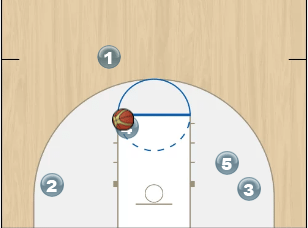
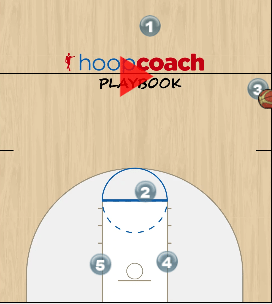
- The Reversal: Player 1 passes to Player 3, who has lifted from the weak-side block to the right wing area.
- The Clear-Out: Immediately upon releasing the pass, Player 1 executes a baseline cut, clearing all the way to the deep left corner.
- The Setup: Player 3 reverses the ball to Player 2 at the top of the key.
- The Objective: The defensive shell has now been shifted from right to left, and back to the center. By clearing Player 1 to the opposite corner, the floor is balanced (Players 1 and 3 in the corners/wings), effectively emptying the middle third of the half-court for the primary action.
Phase 3: The Double High Screen
The floor is now spread, and the ball is in the hands of the primary playmaker at the top of the key.
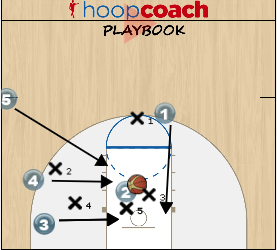
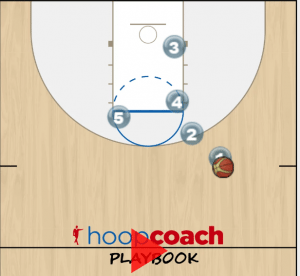
- The Action: Players 4 and 5 sprint from the free-throw line area to set a flat, double high ball screen for Player 2.
- The Attack: Player 2 uses the screens, driving downhill to their right.
- Roll and Pop: As Player 2 turns the corner, the screeners execute a split action. Player 4 (the first screener) rolls aggressively to the front of the rim. Player 5 (the second screener) pops to the top of the key.
- The Reads: Player 2 processes the defense and makes one of three primary reads:
- Attack the rim for a finish if the drop coverage is too deep or the defense trails the play.
- Deliver the ball to Player 4 on the roll if the weak-side tag defender stays attached to the perimeter.
- Kick back to Player 5 on the pop if the defense heavily collapses the paint to stop the drive and the roll.
Teaching Points for Practice
To ensure proper execution when installing this set, emphasize the following details in your film sessions and walkthroughs:
- Pace of Reversal: The passes from 1 to 3, and 3 to 2, must be thrown with velocity and accuracy. If the ball stalls on the perimeter, the defense has time to recover and establish proper gap positioning.
- Screening Angles: Players 4 and 5 must be disciplined in their screening angles. They need to establish a legal, wide base to force the on-ball defender to navigate over the top, creating a brief numbers advantage for the offense.
- Downhill Mentality: The play fails if Player 2 attacks laterally. Player 2 must come off the double screen aiming for the painted area. The threat of penetration is what forces the defensive bigs to commit, which in turn opens up the roll and pop options.
Take a look at the animation of for details ===> Box – Double High Screen