End-of-Game Full-Court Play: “Oregon Last Second” Breakdown
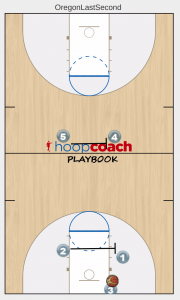
Executing efficiently with limited time on the clock requires precise spacing and timing. The sequence detailed in the “OregonLastSecond.mp4” animation demonstrates a highly structured full-court inbound play designed to advance the ball rapidly against defensive pressure.
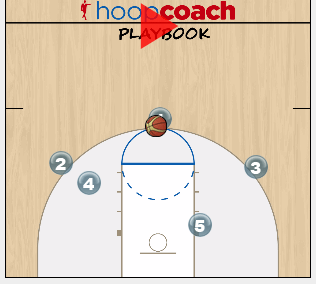
Based on the visual evidence in the “OregonLastSecond.mp4” file and the supplemental end-of-game sequence outlined by Hoop Coach, this play utilizes staggered cross-court screening actions to generate momentum for the ball handler and create immediate downcourt passing windows.
Below is a technical breakdown of the play’s progression.
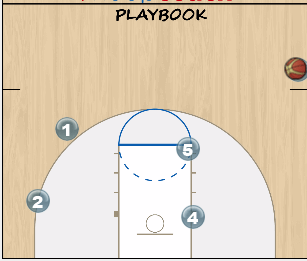
Initial Set
The setup maximizes court length to force the defense into covering expansive areas.
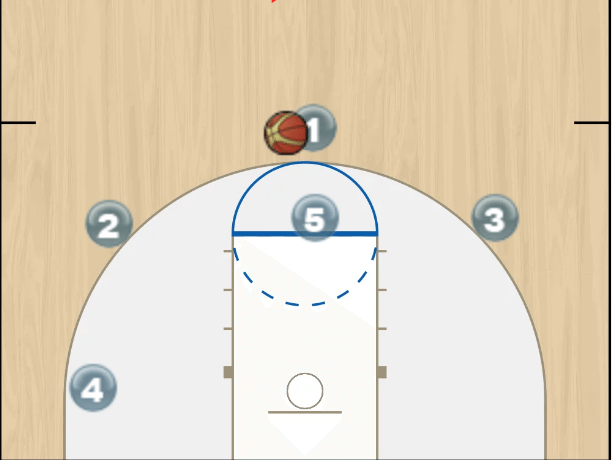
- The Inbounder: Positioned out of bounds on the far baseline.
- Players 1 & 2: Positioned symmetrically near the backcourt free-throw line.
- Players 4 & 5: Stationed further down the court, positioned near the half-court or frontcourt free-throw line to stretch the defense vertically.
The Initial Action: Backcourt Cross-Screen
The play is initiated by an immediate cross-screen in the backcourt to free the primary ball-handler.
- Player 2 moves horizontally across the backcourt paint to set a firm screen for Player 1.
- This action is designed specifically as a 2-screening-across-for-1 sequence.
- Player 1 uses the screen, cutting decisively toward the ball side of the floor to create separation from their primary defender.
The Inbound Catch
The timing of the inbound pass must perfectly align with Player 1’s momentum.
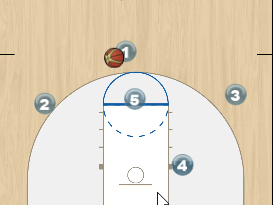
- The inbounder delivers a lead pass to Player 1 as they come off the screen.
- The objective is for Player 1 to catch the inbound pass while already on the run. Receiving the ball in stride prevents the defense from easily trapping in the backcourt and generates immediate downhill speed.
Secondary Actions and Downcourt Progression (Post-Catch)
While the “OregonLastSecond.mp4” animation concludes at the catch, the full structural progression of this specific end-of-game set includes continuous downcourt screening to facilitate a quick score.
- As Player 1 secures the ball and begins advancing, Player 5 sets a cross-screen for Player 4 further down the court.
- This secondary screen is executed so that Player 1 can immediately look to “hit ahead” with a transition pass to Player 4.
- Following the screen for Player 4, Player 5 is then instructed to pick and roll hard directly to the rim, providing a final finishing option near the basket.
Creating an Advantage
- Momentum Generation: By forcing the primary ball-handler to catch the ball on the run, the offense dictates the pace and prevents stagnant backcourt traps.
- Layered Progressions: The sequential screening actions (2 for 1, followed by 5 for 4) force multiple defensive switches across the full length of the court in a severely compressed timeframe.