Two Guard Set with High Post Entry: Play Breakdown and Analysis
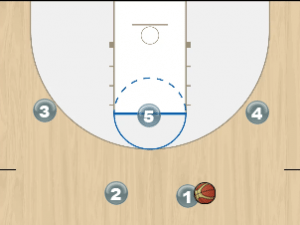
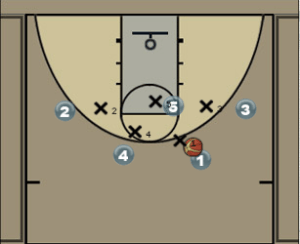
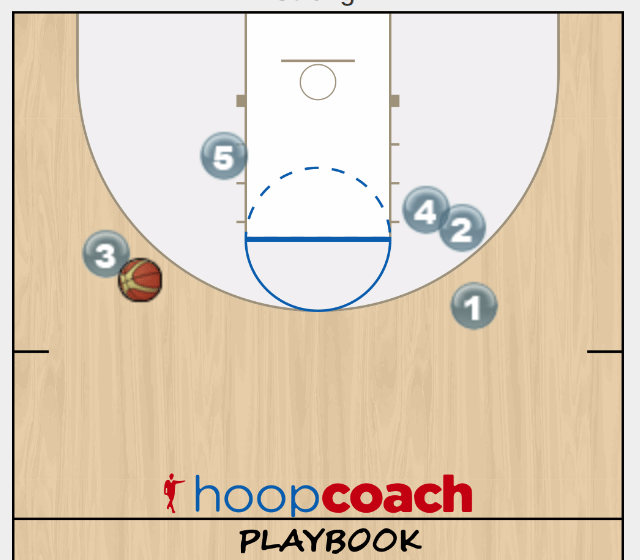
Executing a highly structured offense against a half-court man-to-man defense requires continuous movement, precise spacing, and multiple scoring options. The “Two Guard Set with High Post Entry” is a complex, multi-option set that utilizes a two-guard front, high post activation, a shuffle cut, and a concluding ball screen.
Below is a detailed breakdown of the play’s structure and execution.
Initial Set
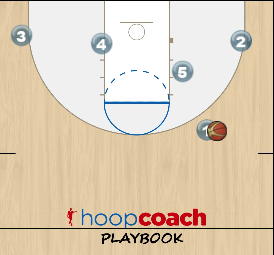
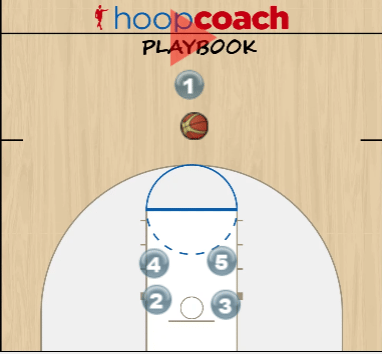
The play begins in a standard two-guard front.
- The Perimeter: The point guard (1) and shooting guard (2) start at the top of the key, balancing the floor. The wings (3 and 4) are spaced wide on the perimeter, typically near the free-throw line extended or dropping into the corners.
- The High Post: The center or power forward (5) establishes a presence at the high post (the free-throw line area). This alignment clears out the paint, removing rim protectors from the low block and creating natural cutting lanes.
The High Post Entry
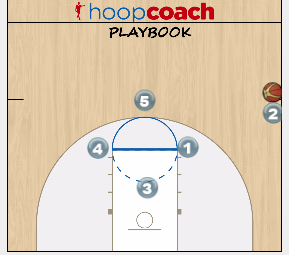
The primary action initiates with a pass to the high post. Entering the ball to the center of the floor at the free-throw line forces the defense to contract.
- Once the 5 catches the ball at the high post, they become the offensive hub.
- The defense must make a choice: pressure the ball handler, jump into the passing lanes, or sag into the paint to stop immediate drives. This momentary defensive adjustment dictates the success of the ensuing cuts.
The Shuffle Cut
Immediately following the high post entry, the offense executes a shuffle cut to punish defensive ball-watching.
- A perimeter player (often the 2-guard or the weak-side wing) cuts hard across the lane, utilizing a screen to scrape off their defender.
- The cutter aims directly for the low block or the rim.
- The 5, holding the ball at the high post, reads the cutter’s defender. If the defender trails or gets caught on the screen, the 5 delivers a quick bounce pass or lob to the cutter for a high-percentage layup.
The Ball Screen Continuity
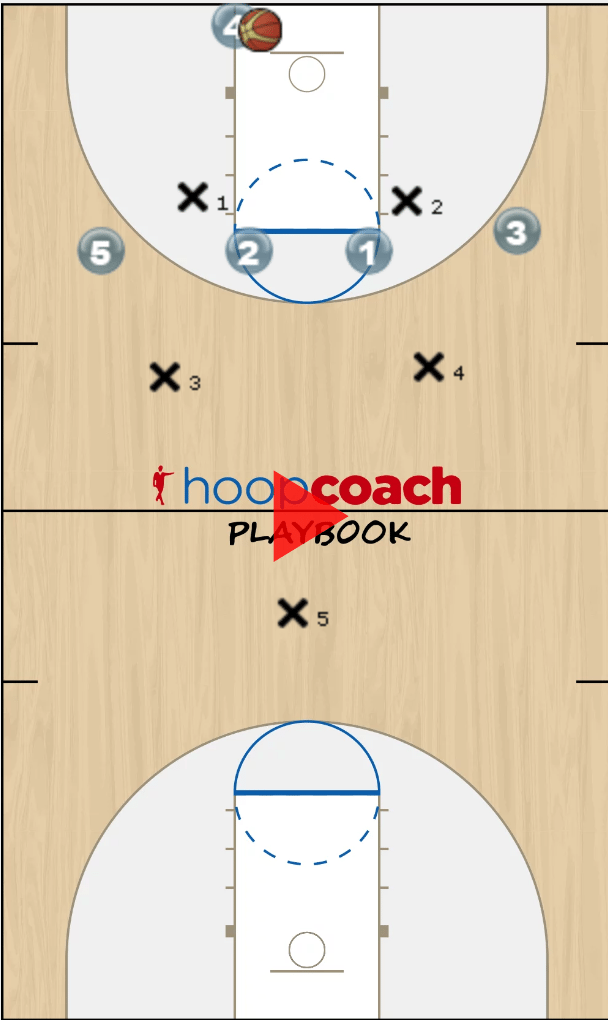
If the defense successfully navigates the shuffle cut and denies the interior pass, the play seamlessly transitions into a secondary action: a ball screen.
- The cutter clears out to the perimeter to maintain floor spacing.
- The 5 then pivots into a dribble hand-off (DHO) or steps out to set a traditional ball screen for one of the remaining guards.
- This initiates a pick-and-roll or pick-and-pop scenario on the perimeter. Because the previous shuffle cut forced the defense to rotate and communicate, the ensuing ball screen often catches defenders out of position or late on their switch.
Why This Play Is Effective Against Man-to-Man Defense
This specific set works because it layers multiple offensive concepts into a single possession:
Late-Clock Reliability: By terminating the set in a ball screen, the offense has a built-in pressure release. If the initial complex actions fail to generate an open look, a structured pick-and-roll ensures a high-quality possession before the shot clock expires.
Emptying the Paint: Starting with a high post entry naturally brings opposing bigs away from the rim, neutralizing shot blockers.
Forcing Defensive Discipline: The shuffle cut requires excellent off-ball defensive communication. A single missed switch or delayed rotation results in an uncontested layup.
PDF Diagrams for Two Guard Set with a High Post Entry | Animation