Continuity Pick and Roll Offense
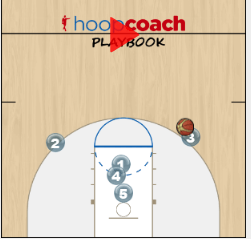
The Continuity Pick and Roll Offense is a structured man-to-man offensive scheme. The system operates on a continuous loop where two post players take turns lifting from the low blocks to set on-ball screens for wing players as the ball moves from side to side.
Flow
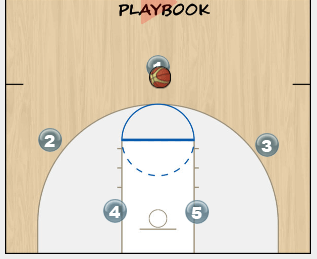
1. Base Alignment & Spacing
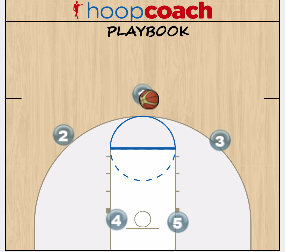
- Formation: The set begins in a 3-out, 2-in double-post alignment.
- Perimeter: Player 1 controls the ball at the top of the key, flanked by Player 2 on the left wing and Player 3 on the right wing.
- Interior: Player 4 sits on the left low block, and Player 5 occupies the right low block.
2. Entry & Clearing the Side
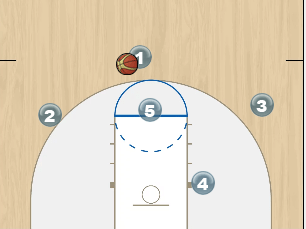
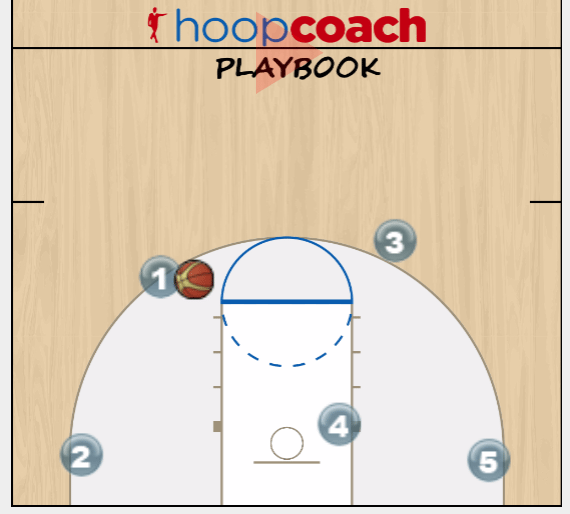
- Perimeter Entry: Player 1 dribbles toward the left wing side.
- Baseline/Lane Cut: As Player 1 moves left, Player 2 cuts through the lane and clears out to the opposite corner/side.
- Tactical Objective: Clearing Player 2 empties the side of the court, removing perimeter defenders from help position and creating maximum space for the upcoming ball screen.
3. High Ball Screen Initiation
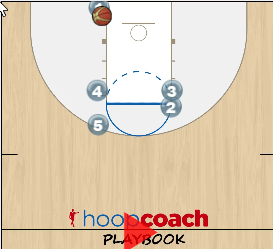
- Post Lift: Low post player 4 lifts from the left block up toward the left wing/elbow.
- Screen Setup: Player 4 sets an angled high/side ball screen for Player 1.
- Attack Phase: Player 1 turns the corner off Player 4’s pick to attack downhill, setting the continuous action into motion.
How the Continuity Operates
If the initial pick-and-roll does not yield a direct lay-up, pull-up jumper, or pass to the rolling big man, the offense flows into its repeating loop:
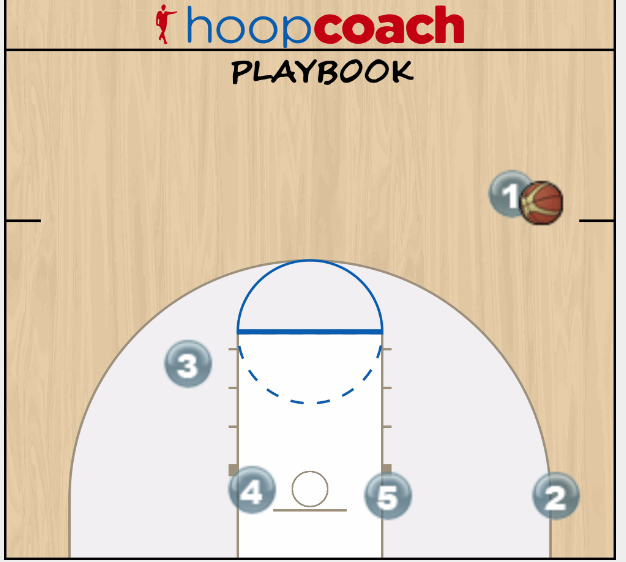
- Ball Reversal: Player 1 swings the ball back around the perimeter to the opposite side (Player 3 on the right wing).
- Opposite-Side Ball Screen: As Player 3 catches the ball, the opposite post player (Player 5) lifts from the right low block to set a ball screen on the right wing.
- Interior Relocation: Player 4 completes their roll to the rim and relocates to the low post block vacated by Player 5.
- Symmetrical Loop: The ball screen sequence repeats on the opposite side. The action continues side-to-side until the defense commits a coverage mistake, yielding an open drive, roll to the rim, or kick-out shot.
Execution
Pacing & Timing: Wing handlers must wait for the post player to establish a firm screening angle before attacking to avoid offensive fouls and maximize driving leverage.
Defensive Fatigue & Errors: Forcing man-to-man defenses to communicate, hedge, switch, or drop through multiple pick-and-rolls on a single possession increases the likelihood of a defensive miscommunication.
Simple Reads for Ball Handlers: The perimeter isolation limits help options, simplifying decision-making for the ball handler (drive, hit the roller, or reverse).