Play Breakdown: Scissor Cut, Flex Screen, and a Double Screen for Your Shooter
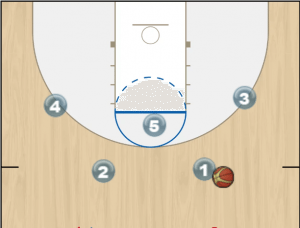
The “L.A.” set is a half-court man-to-man play that chains three proven actions into one possession: a scissor cut off the high post, a flex screen to the rim, and a double screen to free your best shooter. Because the defense has to survive all three actions in sequence, every option flows into the next — and if the first two looks are covered, the play finishes with a clean catch-and-shoot for your shooter.
Here’s the full execution breakdown, the scoring option at each stage, and the coaching points that make it run. View the animated play and print the PDF in Hoop Coach Playbook Pro.
Why Run the L.A. Man-to-Man Set?
Most quick-hitters give the defense one action to defend. The L.A. set forces them to navigate a scissor cut, a flex screen, and a double screen back-to-back-to-back. Each action opens its own scoring window, so the offense always has a built-in counter instead of a one-and-done call.
It fits teams that:
- Want to get a designated shooter a clean look as the primary option.
- Run disciplined screening and value timing over isolation.
- Need a man-to-man set with multiple reads inside a single possession.
L.A. Set: Initial Alignment
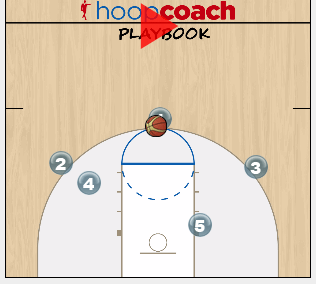
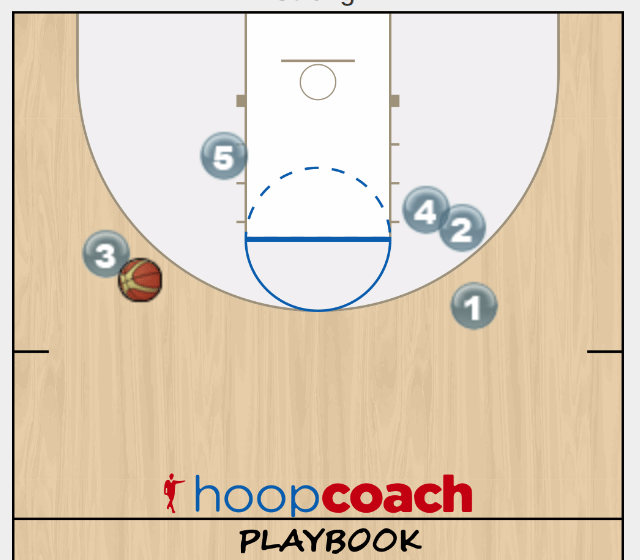
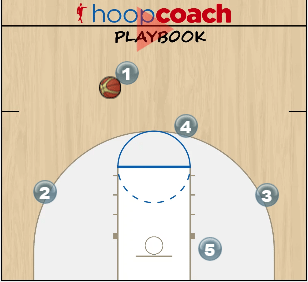
Set up in a two-guard front with a high-post player and two wings:
- 1 (Point Guard): Top of the key with the ball, slightly to the right.
- 2 (Shooting Guard – the shooter): Top of the key, left side.
- 3 (Wing): Right wing, at the foul-line extended.
- 4 (Forward / Post): Left wing, at the foul-line extended.
- 5 (Post): High post, inside the lane at the free-throw line.
How to Run the L.A. Set: Step-by-Step Execution
Phase 1 — Wing Entry
- 1 dribbles toward the right side and enters the ball to 3 on the right wing.
- 2 stays at the top, 4 holds the left wing, and 5 stays at the high post. The entry pass shifts the defense to the strong side and sets up the scissor.
Phase 2 — Scissor Cut Off the High Post
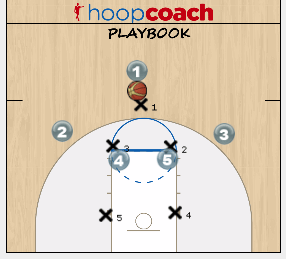
- As 3 catches on the wing, 1 and 2 cut down toward 5 and scissor — crossing tightly, shoulder-to-shoulder, right underneath 5 at the high post.
- The two guards split back out of the scissor: 1 to the left elbow/slot, 2 to the right elbow/slot. 5 acts as the pivot, and the crossing action forces the on-ball defenders to fight through or switch.
Scoring Option 1: A guard rubbing his man off 5 and slipping open off the scissor.
Phase 3 — Flex Screen to the Rim
- 1 and 2 lift back up to fill the guard spots up top.
- 4 drops from the left wing down to the block and runs the flex (baseline cross) action — cutting hard across the lane to the rim off a screen near the block.
- The ball is delivered down to 4 cutting along the baseline for a finish at the basket.
Scoring Option 2: The flex cutter (4) catching on the block for a layup.
Phase 4 — Double Screen for the Shooter
- If the flex cut is covered, the ball is reversed back out to 1 on the left wing.
- On the right side, 5 (stepping up from the high post) and 3 form a double screen.
- 2 — the designated shooter — sprints off the double screen to the right wing/elbow. 1 delivers the pass as 2 clears the second screener.
Scoring Option 3 (Primary Look): The shooter (2) coming off the double screen for a catch-and-shoot jumper.
Coaching Points
- Scissor timing: 1 and 2 must cross nearly shoulder-to-shoulder under 5. A loose scissor lets defenders slide through and recover.
- Use the post: 5 should stay big and wide at the high post so both guards can rub their defenders off him on the scissor.
- Flex angle: On the cross-screen, screen the defender’s body — not a spot on the floor — and have 4 cut all the way to the rim, not to the elbow.
- Sharp ball reversal: The pass back out to 1 is what shifts the help and springs the double screen. It has to be on time.
- Shooter footwork: 2 should set up his defender before sprinting off the double screen, and be ready to either curl or pop depending on how he’s played.
- Spacing: Keep the weak side cleared so there’s no help waiting when the shooter catches.
Frequently Asked Questions
What is a scissor cut in basketball?
A scissor cut happens when two players cut closely past a post player from opposite directions, crossing like the blades of scissors. In the L.A. set, the two guards scissor off the high-post player, which makes it hard for their defenders to stay attached.
What is a flex screen?
A flex screen is a baseline cross-screen. A teammate cuts off it across the lane to the rim for a layup. It’s the signature action of the flex offense and the second option in this set.
Who is the double screen for?
In the L.A. set, the double screen is set on the strong side to free the designated shooter, who comes off it to the wing for a catch-and-shoot jumper — the play’s primary scoring option.
Is the L.A. set good against man-to-man defense?
Yes. It’s a man-to-man set by design. Stacking a scissor cut, a flex screen, and a double screen into one possession stresses defensive communication and gives the offense three sequential counters.
Run It in Practice
The L.A. set rewards repetition — the scissor timing, the flex cut to the rim, and the shooter’s footwork off the double screen all need reps before it’s game-ready. Watch the full animation and download the printable PDF in Hoop Coach Playbook Pro to install it with your team.
Related man-to-man sets:
Continuity Pick and Roll Offense
Lots of actions in this Man Set so you should probably take a look at the animation here and print out the PDF if you have Hoop Coach Playbook Pro.