Dayton: A Man-to-Man Play Out of a High Stack Set
If you want one set that gives your offense four legitimate ways to score from a single alignment, Dayton is worth adding to the playbook. It’s a man-to-man play run out of a high stack set, and it layers a double screen, a backscreen, a pick & roll and a stagger into one continuous flow. The beauty of it is that defenses have to defend all of those actions in sequence, and the timing of each read is what breaks them down.
Below is a full breakdown of how the set forms, what each option is designed to do, and the coaching points that make it work. You can also grab the free PDF and watch the animation in our play designer at the bottom of the post.
Why Run a High Stack Set?
A high stack compresses the defense before any action starts. By bringing your bigs up to the elbows and stacking shooters behind them, you force defenders to guard in tight quarters near the top of the key. That does three useful things:
- It clears the basket area so cutters and rollers have a runway to the rim.
- It disguises the play. Every option starts from the same picture, so the defense can’t cheat early.
- It puts screeners in position to spring multiple actions without long travel, which keeps the timing crisp.
That last point matters more than anything in this set. Dayton only works when each screen arrives on schedule — early and the defense recovers, late and the window closes.
The Starting Alignment
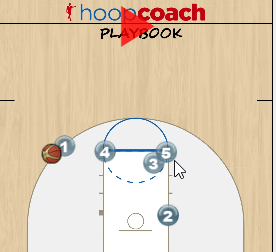
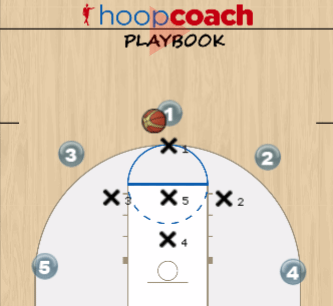
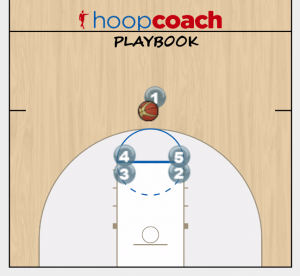
The play begins in a high double stack:
- 1 (point guard) has the ball at the top of the key.
- 4 and 5 (your bigs) sit side by side at the elbows, forming the front of the stack.
- 3 is stacked directly behind 4 on the left.
- 2 is stacked directly behind 5 on the right.
From the defense’s point of view, all five offensive players are bunched between the foul line and the top of the key. Nothing has tipped off where the ball is going yet.
Step 1: Spacing Out of the Stack
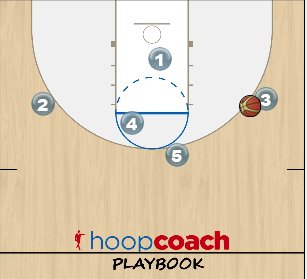
The first movement is the entry. The two perimeter players release from behind the bigs and space to the wings:
- 2 pops out to the left wing.
- 3 spaces to the right wing.
- 4 and 5 hold their positions at the elbows.
- 1 keeps the ball at the top.
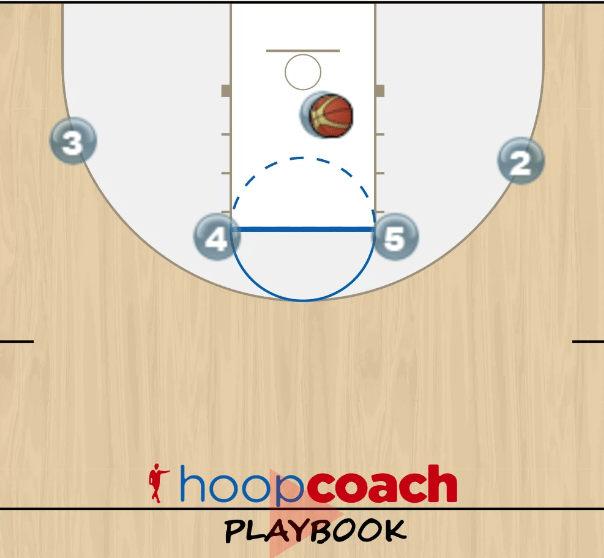
This settles the offense into a balanced 1-2-2 look with the bigs high and shooters wide. This entry is the portion captured in the play animation — the stack opening into the spread the scoring options launch from. Getting this spacing right is step one: if your wings drift too high or too flat, the screening angles that come next won’t line up.
The Four Scoring Options
From that spread, Dayton flows into its reads. Coach the players to take them in order — the first open look wins, and the later options only exist because the earlier ones occupied the defense.
Option 1: The Double Screen
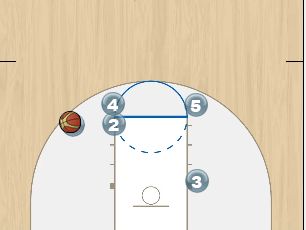
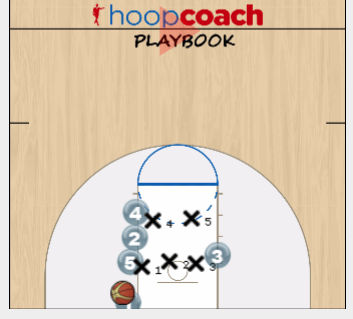
The two bigs set a double screen for one of the perimeter players coming off the wing or baseline. Stacking two screeners back to back makes it very hard for the defender to fight over or under cleanly, and it frees a shooter coming to the ball. If the defense dies on the double screen, this is your first shot.
Option 2: The Backscreen
If the defense overplays the double screen and jumps the shooter, the backscreen punishes them. A screener turns and sets a blindside screen for a cutter heading to the rim. Because the defense is focused up top on the ball and the shooter, the backside cut to the basket often comes wide open for a layup or lob.
Option 3: The Pick & Roll
Next is the pick & roll with the ball handler and a big. This is your counter when the defense has collapsed inside to take away the cuts and the double screen. The screener rolls hard to the rim while the spacing from the wings keeps help defenders honest, giving the ball handler a true two-on-two read: turn the corner, hit the roller, or kick to a spaced shooter.
Option 4: The Stagger Screen
The final option is a stagger screen — two screens set in succession (rather than side by side) for a shooter running off them. The stagger forces the defender to navigate two separate obstacles, and by this point in the possession the defense is usually scrambled. It’s a clean release valve that turns into a catch-and-shoot or a curl to the lane.
Coaching Points
- Timing is everything. Each option should arrive a beat after the previous one is taken away. Walk through it at half speed first so players feel the rhythm before you run it live.
- Screen with intent. Sprint into screens and hold them. A soft, drifting screen gives the defender room to recover and kills every read downstream.
- Read, don’t robot. Dayton is a menu, not a script. Teach players to attack the first advantage the defense gives up rather than racing to the last option.
- Space the corners. Your non-involved shooters must stay wide and ready. Their spacing is what stops the help defense from loading up on the roll and the cuts.
- One pass can reset it. If nothing opens up, the high stack alignment lets you swing the ball and re-run the action without a turnover-prone scramble.
When to Use Dayton
This set fits best against a disciplined man-to-man defense, especially late in the clock when you need a designed look with built-in counters. It’s also a strong out-of-timeout call: because the options run in sequence, you’ll almost always find a defender a step behind on at least one of the four actions. It rewards teams with at least one big who can both screen and roll, and shooters who can come off screens under control.
Get the Play
Download the full PDF diagrams or watch the animation in our play designer to see the spacing and timing for yourself.
- 📄 PDF diagrams: https://www.hoopcoach.org/wp-content/uploads/2016/03/Dayton.pdf
- ▶️ Animation in the play designer: https://www.hoopcoach.org/playbook/play.php?id=14623&user=2994&name=Dayton&category=Man%20to%20Man%20Offense
Looking for more man-to-man sets with multiple scoring options? Browse the full Basketball Plays library on Hoop Coach.
Want plays, drills and coaching breakdowns like this every day? Join 12,000+ coaches getting the free Hoop Coach newsletter at the top of the page